
Which California Arrest Records Are Public?
The California Public Records Act opens the core facts of an arrest to the public. State and local agencies both answer to it. Still, that openness has edges. Disclosure can be limited when it might endanger a person or an active investigation. And not every record lands on a website. An arrest record describes an event. It may not show whether charges were filed. It may not show whether the person was released, or how the case resolved in court. So ask a sharper question first: which record actually answers this lookup? The arresting police department may hold the initial report and the required arrest information. A county jail may show a booking or current-custody entry. A superior court may later hold the filed case and its outcome. Each custodian keeps different files, updates them on different cycles, and follows different disclosure rules. A state-prison offender search, meanwhile, reflects state custody rather than a fresh county booking. For a statewide map of booking and photo sources, see the California recent-arrest overview.
What California Arrest Details Are Public?
Government Code section 7923.610 spells out the arrest information a state or local law-enforcement agency must release. The exception is when doing so would endanger a person's safety or an investigation. The required details go well beyond a name and a charge. They can pin down the event itself. They can let you compare a booking entry against an arrest report, or point you to the right custodian. Treat the statute as a floor for disclosure, though. It is not a promise that every field shows up in a searchable roster. The current California arrest-information statute lists these categories:
| Public arrest detail | What it can show |
|---|---|
| Identity and description | Full name, occupation, date of birth, eye and hair color, sex, height, and weight. |
| Arrest event | Time and date of arrest, location, and factual circumstances surrounding it. |
| Booking event | Time and date the person was booked. |
| Custody or release | Bail, time and manner of release, or the current location where the person is held. |
| Case and hold information | Charges, outstanding warrants, and parole or probation holds. |
The agency may withhold or redact items within a lawful limit. Another law can shield a record or a person. The table maps the statutory categories, not a promise that every request returns every item. A blank online field proves nothing. The office may still hold the record even if it never posted it.
Note: Online rosters are local publishing choices; the public-information rule does not require a single statewide photo search or common roster format.
Request California Arrest Records Under CPRA
Anyone can ask the agency holding a California arrest record for a copy. A strong request names the office and the record type. From there, narrow things down. Give a date range, a place, a person, and an incident or case number. Then add a way to receive the reply. Requesting the specified arrest information is one path; asking for a particular record is another. For example, seek the booking entry, the arrest report, and the booking photograph separately. One request rarely covers every file. Government Code section 7922.535 gives the agency ten days to decide. The agency must judge whether the requested records fall under disclosure rules. Unusual circumstances allow an extension of that first determination. The clock does not force the full production of records by day ten. The CPRA determination-time rule covers only the initial response. Gathering the records can take longer. An agency may redact protected details or cite an exemption instead. Here is a practical sequence that keeps each request with the right custodian:
- Identify the arresting agency or county jail that likely holds the record.
- Give a useful date range, location, name, and case or incident number if known.
- Name each record sought, such as arrest information, a booking entry, or a report.
- Ask the agency to identify withheld material and the basis for any redaction or denial.
The CPRA sets no single statewide fee for a booking photo. Agencies may charge direct duplication costs under the records law. Local copy policies shape both format and price. Photo requests also get their own separate disclosure review. Check the agency's current procedure before sending payment. Never read a delay as a denial.
California Mugshot Law and Its History
California's photo rules break into three parts. One covers public arrest facts. Another gives each agency discretion over the image itself. A third bars charging the arrested person to take a booking photo down. That third rule lives in Civil Code section 1798.91.1. Its title is "Commercial Use of Booking Photographs." Senate Bill 1027, chapter 194 of 2014, added it. The law took effect on January 1, 2015. In plain terms, a person or business that publishes or shares a booking photo may not demand money or anything of value from the subject. The ban covers removing, correcting, altering, or withholding that image. The statute defines a booking photograph. It means an image of an arrested person taken pursuant to an arrest or another involvement in the criminal justice system. Every payment taken in violation counts on its own. The subject can sue for the greater of one thousand dollars per violation or actual damages. Costs and reasonable attorney fees come on top. Equitable relief is available as well. A public entity may still charge a reasonable administrative fee to correct a booking photograph. That narrow allowance never authorizes a private publisher to charge the subject for removal. The law has real limits. It does not force any agency to publish a mugshot. It creates no blanket right to erase an accurate page. And it leaves the rules for arrest records and court sealing exactly where they were. A person facing a dispute should keep the page address and any relevant legal documents. Use the publisher's own correction route. Seek counsel when a court order or claim is involved. Third-party copies do not vanish on request. A copy held elsewhere may simply stay up. The California Legislature's section 1798.91.1 page carries the statutory text. It shows the official title, the anti-payment language, and the remedies available to a subject.
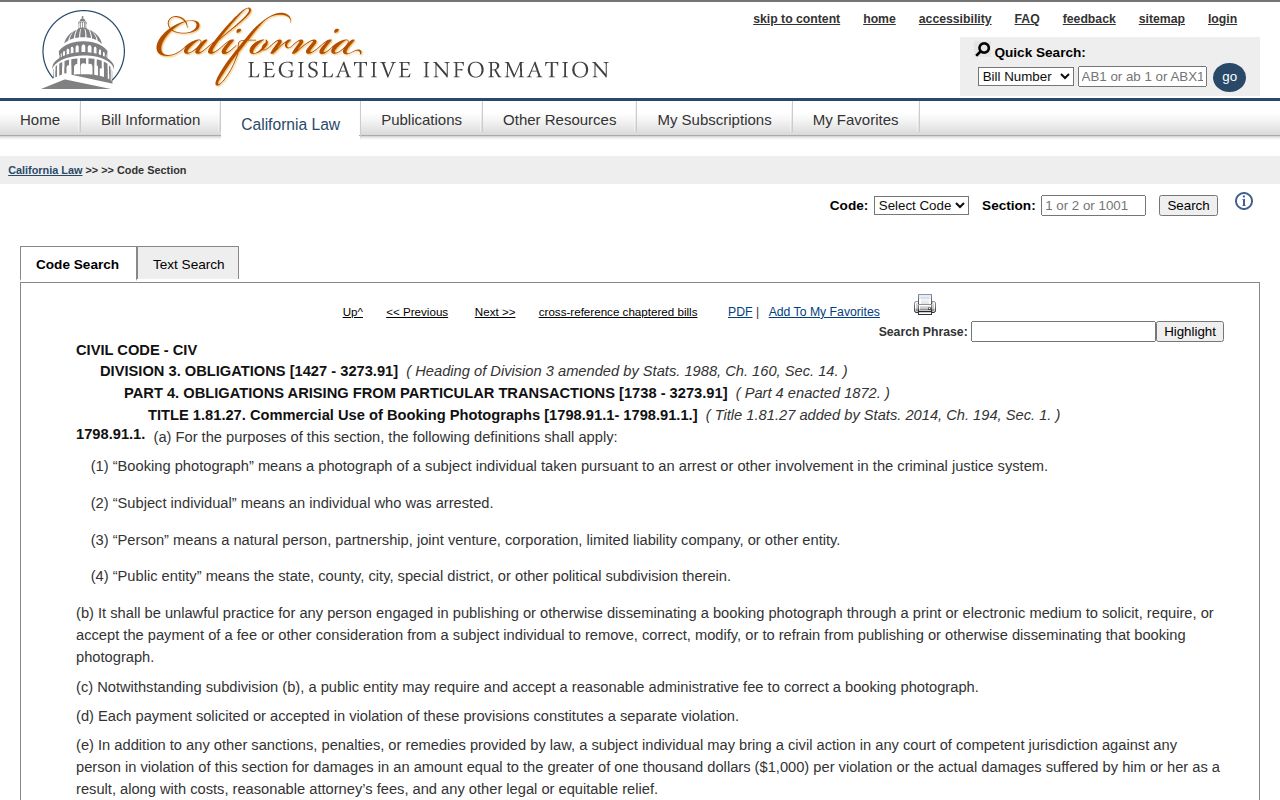
The image displays the statute's official text. It is not a record for any one person. The payment ban targets commercial removal schemes while leaving disclosure decisions and other correction paths separate.
California Booking Photo Access Is Separate
Attorney General Opinion 03-205 asked whether a sheriff may hand booking photos to the public and the media. The answer was yes, with conditions. An agency has discretion to provide a copy because the image can fall within a law-enforcement investigative exemption. Arrest information required by statute must still be disclosed. And equal treatment applies once a photo is out. If an agency has given the image to one member of the public, the opinion says it must make that image available to other requesters on equal terms. That is important background. It is not a command that every jail post every booking image online.
The Attorney General's Opinion 03-205 cites the older California Supreme Court decision People v. McInnis, 6 Cal.3d 821 (1972). That case makes a historical point. Booking materials and photographs can remain in law-enforcement files regardless of how a case later ends. The holding sets no modern roster window. Nor does it decide whether a photo stays visible on a given agency site. No published appellate ruling squarely interprets the payment ban. That statement covers only reported appellate authority. Complaints, trial matters, settlements, and unpublished disputes all sit outside it.
The Legislature also limits some police social-media posts. That is a separate question from a records request. An agency may show no photo on its roster, may decline an image request under a valid exemption, or may hold a record the public interface never displays. The source agency can explain its policy. It can also state the legal basis for any response.
Note: A missing photo can reflect an agency’s publication choice or an expired display window, not a finding about guilt or the existence of an arrest record.
California Juvenile Arrest Records Stay Confidential
Youth arrests sit outside the ordinary public record. Rule 5.551 of the California Rules of Court defines the juvenile case file. Its terms are sweeping. Papers filed with the court count. So do probation reports, social-worker reports, transcripts, exhibits, photographs, digital images, and recordings. Anything else kept for the juvenile court counts too. Confidentiality is the default. Access requires a statute or court rule that opens the door. Outsiders must usually petition the juvenile court first. The judge can then grant limited access or hand over redacted material. The California Courts confidentiality rule also keeps any stricter state or federal privacy law intact. Keep that in mind when reading an adult jail roster. A blank line there means nothing. Many juveniles are handled through juvenile court or probation rather than an adult booking entry. Ask the arresting agency or the court whether a lawful access route exists. Leave protected names and images alone.
California Arrest Relief Has Four Different Paths
California does not run every record problem through one door. Relief comes in several distinct forms. People say "expungement" loosely, but that label should not blur the separate legal routes. Match the request to the actual case outcome, and read the court or Department of Justice notice before asking an agency or publisher to change anything.
| Relief route | What it means | Key limit |
|---|---|---|
| Petition to seal an arrest, Penal Code section 851.91 | For an arrest that did not result in conviction, a person may petition when an eligibility condition applies, such as a limitations period ending without a filing, a qualifying dismissal, or acquittal or vacatur. | Exclusions apply, including specified serious cases and circumstances involving evasion or identity fraud. Eligibility does not itself send deletion orders to every publisher. |
| Pre-filing or diversion relief, section 851.87 | A qualifying diversion or other covered circumstance can support a petition and court process; an order may permit a person to answer that the covered arrest did not occur. | Authorized law-enforcement access is preserved, and conditions, notice, and hearing rules apply. |
| Factual innocence, section 851.8 | A person may seek a court finding of factual innocence and related sealing or destruction relief. | The proof and timing standards are demanding. A dismissal or reduced charge alone does not establish factual innocence. |
| Automatic arrest relief, section 851.93 | The Department of Justice reviews its statewide data each month for qualifying arrests, including specified no-proceeding or no-conviction outcomes and eligible diversion. | Timing varies by case type: the statute uses one year for certain misdemeanors, three years for many felonies, and six years for felonies punishable by at least eight years. Relief preserves authorized access and does not instantly erase every local file, photo, or outside copy. |
| Conviction dismissal, section 1203.4 | A qualifying person who completed probation and meets statutory conditions may seek dismissal of a conviction. | It changes the criminal-case status. It is not the same as sealing an arrest that did not end in conviction. |
California law offers more than one way to clear an arrest record. The statutes lay out distinct paths: petition-based arrest sealing, diversion-related arrest relief, Penal Code 851.8 relief, automatic arrest relief, and conviction dismissal. Each path changes what the public can see in a different way. The California Courts clean-record guidance sorts relief by how a case ended and points to the right forms. The proper court, the case record, and your eligibility facts still steer the choice.
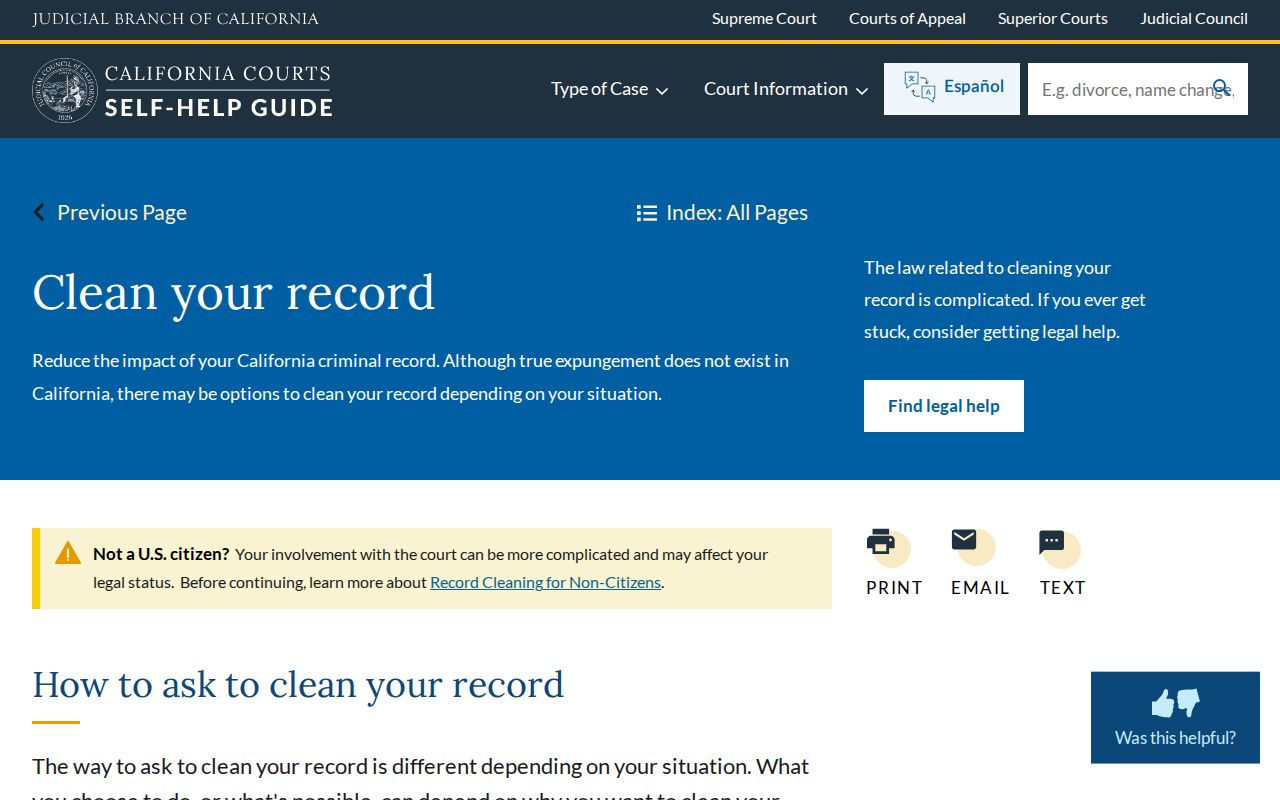
Those court categories matter in practice. An arrest with no conviction is one thing. A conviction that may qualify for dismissal is another. Match the form or court order to the actual record before requesting any update.
California Arrest Relief and Old Copies
A sealing order limits what a court or agency will release. It rarely erases every lawful copy. A jail roster may drop an entry once its display window closes. Yet the booking record remains in the agency file. A court docket can move on its own clock. So can a local report, an old archive, a copied web page, and a search-engine result. One source updates while another keeps its own copy.
After relief, take the notice or order to the originating agency. Do the same with any publisher holding that page. Give the exact record or page address. Ask whether the source has been corrected, sealed, or restricted. A publisher's stale copy proves nothing about official access or about the court's decision. The reverse holds too. A vanished search result does not mean the source record was erased. Search engines refresh stale results after a page is removed or materially changed. That refresh deletes nothing at the source.
Note: Relief changes the legal status of a record under its own statute or order; it is not a universal command to erase every historical reproduction.
California Historical Arrest Records and Retention
California sets no single booking-photo retention period across counties or agencies. Retention turns on the record series and its schedule. It also turns on the custodian, any legal hold, and lasting historical value. State records guidance frames retention as a question of function and value, not format alone. One statewide guideline lists jail daily logs on a "CU + 6" schedule. That example is not a six-year rule for every booking photo or inmate record. Local schedules and facility classification still control.
Older material is a different hunt. The California State Archives guide to historical county records describes sheriff indexes to criminal case files. It also covers jail registers and photographic "mug" files. A register may note when a prisoner arrived and left. It can also list name, age, sex, and residence. Birthplace, occupation, charged offense, case number, sentence, judge, and reason for release may appear too. A photo file may carry a name, filing date, and identification number. Pictures may be arranged by number or name. None of this promises survival. County series were not all kept, transferred to the State, opened, or digitized.
For a transferred series, remote request staff at the State Archives can help. They can spot a likely collection. They identify the series rather than run an unlimited search for one document. Requests are handled in order. A typical research period runs three to five business days. Copying or mailing adds time. Check current service details and fees before ordering a reproduction. For a modern booking, start with the county or agency that created the record. No archive request can bypass a confidentiality rule or a local custodian's current control.
Correct a California Arrest Record at Its Source
Start with one question: which agency made the entry? That office controls the fix. Ask it how a correction works. Then hand over the record number plus any court order or paperwork that backs your request. Paper trails matter here. A court's decision does not always reach every system at once. A police file and a jail export can disagree. So can a state record and an old public page. A CPRA request is useful for finding and getting a copy of a record. It cannot force the agency to rewrite the entry itself.
Copied listings are a different job. Check the official source first, then go to the publisher through its own correction process. One secondary publisher offers a free form built around documentation. It asks for the page address and details that identify the person. A reason and supporting papers are part of it. That page quotes a five-to-ten day review. Treat that as the operator's own estimate, not a California legal deadline. Paying nothing and waiting ten days still does not mean an accurate page comes down. A publisher's policy is never a substitute for an agency correction or a court order. Other sites play by their own rules.
The BustedNewspaper correction and removal form is one such publisher's free documentation-based process. It is not an official California record system. Nor is it a statewide right to delete an accurate report.
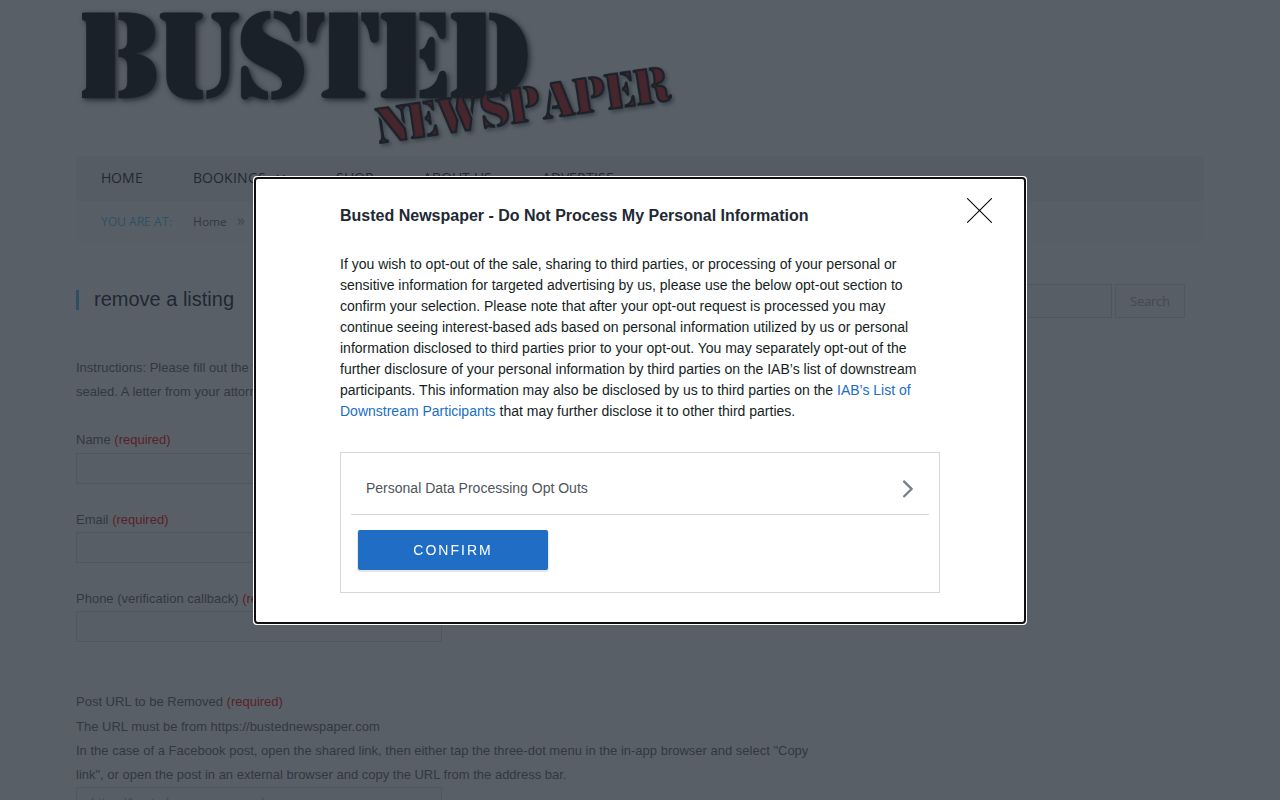
California law bars booking-photo sites from charging a subject for a requested removal or change. That protection has limits. It does not make every accurate online record disappear. No one can honestly sell you a guaranteed court result. Total deletion is not for sale either. Save your request, the reply, and a copy of the source record. Those papers keep any follow-up pointed at the right custodian.
The California County Directory covers local custody records. It points to the county that may hold the booking entry. A careful lookup keeps everything in its lane. The arrest report, the jail record, the court outcome, and any later relief stay separate.
California Police Social-Media Photo Limits
Penal Code section 13665, amended in 2023 and effective January 1, 2024, limits a police or sheriff agency's social-media sharing of a booking photo when the person was arrested on suspicion of a nonviolent crime. Posting is generally off limits. An agency may share the photo only to find a fugitive or counter an imminent threat to a person or public safety, when the image helps locate the person or reduce that threat. Two other doors exist. A judge may order release of the photo for a legitimate law-enforcement interest, or an urgent and legitimate law-enforcement need may justify it. A shared photo must use the name and pronouns the person gave. And the post generally comes down within fourteen days. The same statutory exceptions can extend that period.
The statute defines social media narrowly. Agency websites and data systems sit outside it. So this is not a blanket ban on a jail's structured public-record portal. A social post coming down proves little. It does not show a record was sealed, that a case ended, or that the arrest never happened. The rule simply governs one publishing channel, with conditions and exceptions.
The official Penal Code section 13665 text describes California's arrest-photo limits for social media. It spells out the exceptions too.
A deleted agency post is not the whole story. An official record may still exist under a separate disclosure rule. Confirm status with the agency that holds it.