
How California Recent Arrests Move
No single California page joins every arrest, jail stay, court case, and prison record. The first entry may come from city police, a sheriff, or the California Highway Patrol. The jail then creates its own booking record. Different systems may list different names, numbers, and times for the same event.
Always start with the county where the booking happened. A custody view may show only people still held. Some portals post a clear date range. Others offer a rolling list, a PDF, or no public roster at all. A recent-booking feed can include people released later. A missing name can reflect timing, release, a different jail, or a closed record. It does not rule out an arrest.
Where California Arrests Are Booked
County systems are the main route to a California booking record. The receiving jail holds the custody entry. No statewide patrol agency keeps it. The arresting city and the booking county can differ. A highway stop may land someone in a county jail far from home. A city police arrest may end at a sheriff-run facility. Follow the place named in the official arrest release, then pick that county's source.
The statewide directory links to all 58 county sites. Each page explains its own roster and booking feed. It also covers photo practice and records contact. City police may add an incident report or a local blotter. They do not replace the county's custody status. The county seat is only a routing label, not the location of every jail.
For a name search, choose the county tied to the arrest first. Open its official roster and check the stated date range. Then compare booking numbers, age, county, and custody label before calling it a match. If the name is absent, try the arresting agency's release or records contact. Then ask the county records unit directly.
Could an arrest be missing from the roster? Yes. A fresh booking may not have posted. The person may be out, or the booking sits in another county. One roster is one system's view, not a statewide arrest history.
- Use the arrest location and agency to choose a county from the directory.
- Read the roster’s time window and whether it lists current custody, new bookings, or both.
- Search the available name or booking fields, and compare identifiers before relying on a match.
- Check the linked photo policy, then contact the agency if the record is missing or unclear.
- Use the county records request route for an older or released booking that has left the online view.
California Arrest Windows by Source
"Recent" means whatever the source says it means. Kings County refreshes an hourly 24-hour view. Marin County posts a 48-hour log limited to people still in custody. San Luis Obispo County offers a preceding-24-hour log with at least a one-hour delay. Solano County compiles seven days in 24-hour periods. These are examples only, not a common statewide feed.
| Official source | Published window | What the window means |
|---|---|---|
| Kings County booking search | Last 24 hours, updated hourly | Booking and custody fields; no public roster photo was documented. |
| Marin County Public Booking Log | Last 48 hours | People arrested and booked who remain in custody, plus a current inmate list. |
| San Luis Obispo County Booking Log | Preceding 24 hours | Date and time view with at least a one-hour delay. |
| Solano County booking log | Up to seven days | Daily periods compiled around midnight; not a live 24-hour list. |
The statewide Arrested Today page compares same-day sources and walks through checking a fresh booking. Longer logs may span days or a fixed PDF range, yet a wide window still isn't a full arrest history.
Note: County portals may lag intake, omit released people, or use a date range that differs from the visitor’s local day.
The Kings County official 24-hour search states its time window up front.
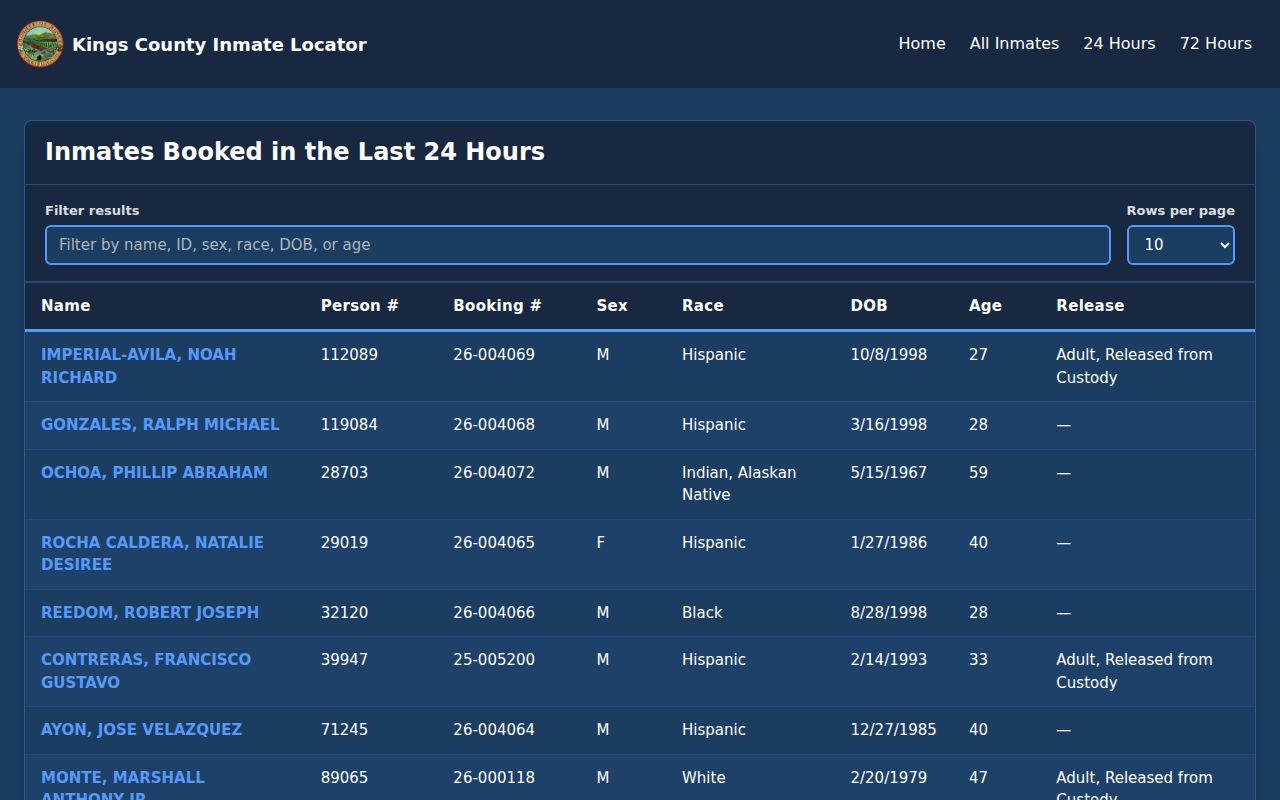
That label sets a fair expectation. Still, someone can be released or transferred before your next check.
California Jail Roster Search Fields
California's 58 counties share no common roster design. Some pages list people currently held. Others add a recent-booking tab, a date filter, a daily report, or a records office link. Field names differ too. Read the roster's own instructions and treat any result as one custodian's snapshot of a California arrest, not the state's full record.
| Search or result field | What it can mean | Check before relying on it |
|---|---|---|
| Name | Person name entered at booking or shown in a custody list. | Compare another identifier; spelling alone may not distinguish people. |
| Booking or person number | An identifier tied to a jail record in systems that expose it. | Do not assume the number carries across counties or agencies. |
| Booking date and time | When the jail records intake, which can follow the arrest. | Read the displayed time zone and publication window. |
| Charges and bail | Charges and release terms recorded at that stage. | They can change; they are not a court finding. |
| Facility and custody status | Where the person is reported held or whether the record says released. | A transfer or later release can make a roster stale. |
| Photo field | An image may appear, be omitted, or be withheld under local policy. | No photo on the roster does not prove that no official photo exists. |
A smart search follows the source. Confirm the county first. Pick the view for current custody or recent bookings, then search by name or number. Match the date, location, and status. If the person is absent, ask the receiving jail whether a booking exists and contact the arresting agency for its arrest record.
Roster coverage follows statewide patterns. Some counties list current inmates, while others open 24-, 48-, or 72-hour booking windows. Date-filtered logs, daily or weekly PDFs, and city police blotters cover other counties. Some places publish no roster at all. A CitizenRIMS portal, custom jail software, or a sheriff app does not make those records statewide or complete.
- Choose the county tied to the arrest or receiving jail.
- Read whether the official page covers new bookings, current custody, or both.
- Search its name or identifier fields and compare the date, facility, and status.
- Ask the custodian when the record is missing, old, or unclear; use its records request route for a copy.
California Multi-Day Arrest Logs
Longer windows reveal a different kind of record. Butte County publishes weekly booking-log PDFs rather than a live 24-hour roster. Solano covers up to seven days in daily periods. Visalia's police department posts municipal arrest logs. A city log can describe the arrest without saying whether the person is still in county custody.
Other county systems use a 48- or 72-hour view, a rolling date range, or a media bulletin whose archive depth that agency sets. Weekend and holiday gaps happen. The next batch may cover several days. California has no common statewide posting hour. Archive periods vary by agency, and a blank page is no promise that no arrest was made.
For a record that has aged out of a same-day view, the California Arrest Reports page compares these longer windows and the blotter route.
| Publisher model | Example | Record boundary |
|---|---|---|
| Weekly county booking PDFs | Butte County booking logs | Past log periods, not a live custody screen. |
| Multi-day county range | Solano County booking log | Up to seven days, compiled in daily periods. |
| Municipal arrest log | Visalia Arrest Logs | One police department’s arrest events, not countywide custody. |
| News or media bulletin | County sheriff and city police release pages | Selected public information, not every booked person. |
Older arrests age out of any live window. Ask the agency that holds the record. A California county directory row routes to that county's own roster and records path for the request. The date on a secondary copy does not set the agency's retention period.
CHP Arrest News and Booking Routes
The California Highway Patrol, or CHP, spreads its arrest news across two very different channels. The newsroom posts selected enforcement stories. CAD, the Traffic Incident Information Page, carries live incident feeds. A release might describe a DUI effort, a fugitive arrest, or a focused operation. It might cover a public-safety event. CAD is incident-oriented, not person-oriented. Neither channel lists everyone booked statewide.
To find a CHP arrestee, start with the release or a CPRA response. Identify the receiving county. Then check that county's jail source for custody. A news release may report an operation's arrest count. The live page shows road incidents picked by a communications center. Neither is a person-search system. A traffic event does not establish that anyone was booked.
California Arrest Data and Courts
California runs 58 superior courts, with criminal case access set county by county. The Judicial Branch's court directory names the proper court. Its case lookup guidance notes that online access differs. A court entry can show filing or disposition details, but it is not a live jail roster, may lack a booking photo, and a booking record can exist before a case is filed. The California Courts directory maps every trial-court destination statewide.
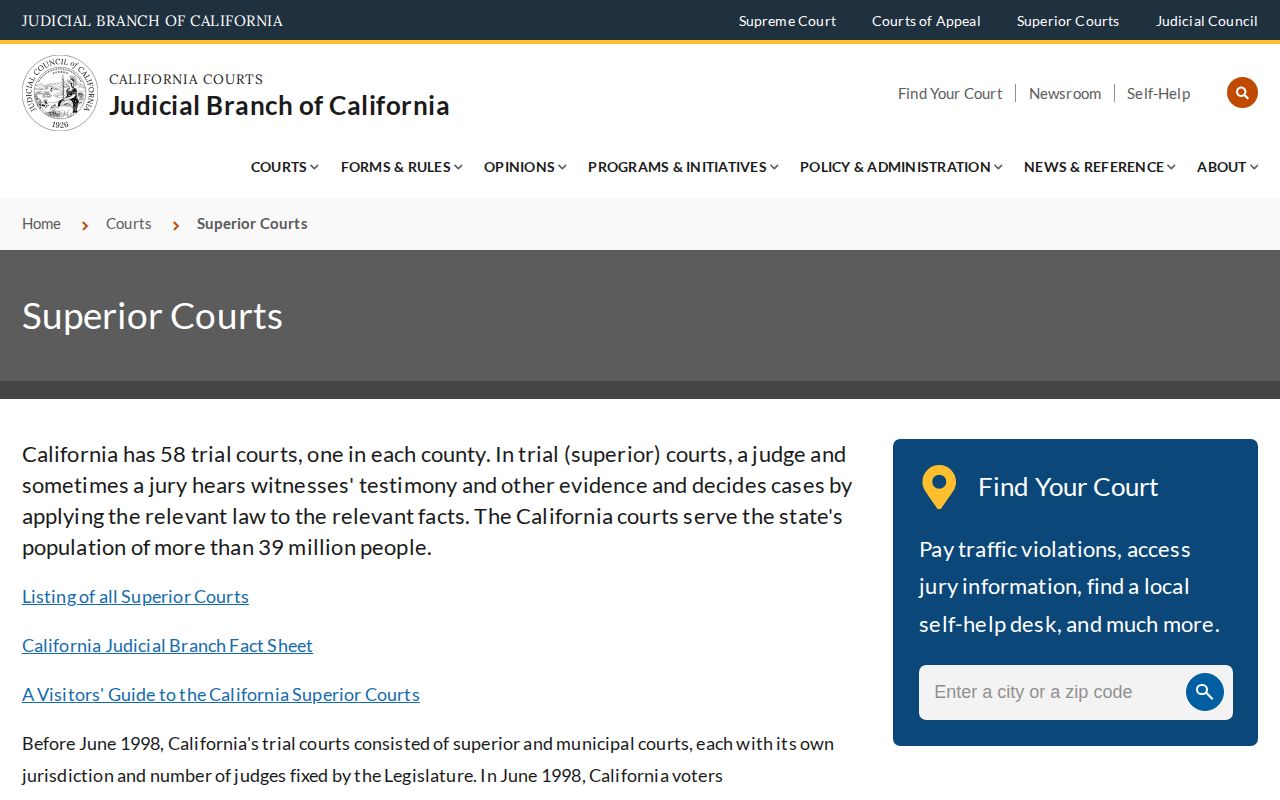
Historical counts are a different search. California DOJ OpenJustice covers arrest data by agency, county, and offense category. The BSCC Jail Profile Survey tracks jail booking and custody measures submitted by local agencies. Both are statistics sources, not same-day arrest searches.
California Arrest Record Fields
Government Code § 7923.610 covers arrest records. It lists the arrest information that state and local agencies generally must release. Safety and investigation limits still apply. Counties go beyond it in different ways. A county booking system may add its own intake fields. A jail's search form may expose only part of the record, and no single California roster layout exists. A booking photo is never promised by the statute.
| Field or record layer | What it can show |
|---|---|
| Arresting agency record | Full name and occupation; date of birth, eye and hair color, sex, height, and weight; arrest date, time, and place; and factual circumstances, subject to lawful limits. |
| Booking and custody entry | Booking date and time; charges, including listed warrants or parole and probation holds; bail; release time and manner; or current holding location. |
| County roster search fields | Name and booking or person number when offered; date or time filters appear in some views. The exact search fields vary by county. |
| Roster result fields | Age or date of birth, sex or race fields, facility, release details, and other custody labels may appear. Do not assume each county shows every field. |
| CDCR CIRIS profile | For state-prison custody, the profile may show name, CDCR number, age, location, admission or commitment data, and release or parole details displayed by the system. |
| Booking photograph | May be held by the custodian, but the public roster can omit it and the agency may have discretion over a copy. |
The current arrest-information statute names its fields directly. Charges, outstanding warrants, and parole or probation holds all make the list. It shows the record at one point in time.
How to Request California Arrest Records
No online roster lasts forever. When one is missing or has rolled past its window, ask the agency that made or holds the record. Jail records units hold the booking files. The arresting department or CHP keeps the initial report. California's Public Records Act process is open to any person, though protected details can be withheld or redacted.
- Choose the likely custodian: the arresting agency for an incident report, the receiving county for booking and custody, or CDCR for a state-prison record.
- Describe the record with the known name, incident or booking number, county, place, and date range. Ask for the booking entry, arrest information, or photo as separate items.
- Use the current public-records form for the agency that holds the record. CHP requests can go through its CPRA process.
- Ask the agency to identify any withheld fields and provide reasonably segregable public material. Confirm copy format and any direct duplication cost before ordering.
Under Government Code § 7922.535, the agency generally has ten days to make an initial determination, with a possible extension for unusual circumstances. That deadline is not a promise that the full record will be produced within ten days. There is no single statewide mugshot fee; agency charges and available formats vary. CHP’s collision-report form follows a separate eligibility path and is not a statewide arrest-report form.
For an older state-held archival series, the California State Archives reference service accepts requests by phone, email, fax, or mail. Its research step generally takes three to five business days, then copying and mailing add time. Current research is listed as free; reproduction fees can apply, such as 25 cents per photocopy page or separate charges for scans, certification, fax, audiovisual, and microfilm work. See the State Archives reference page for current terms.
California Mugshot Access Rules
Who controls the booking photo? The agency holding the booking record sets photo policy. Some California county rosters stay text-only or switch arrest-photo display off entirely. Others post an image under local rules. California Attorney General Opinion 03-205 holds that a sheriff may have discretion to release a booking photograph. The same opinion treats specified arrest information as public. A blank spot on a public page proves nothing about what the agency actually holds.
Prison records are a different animal. The CDCR California Incarcerated Records and Information Search is a separate state-prison lookup. It covers someone already sentenced. It does not promise a public photo in its results. A CDCR media or photo request is its own process. Keep the two systems straight. A county booking image is not a state-prison record. A CDCR profile does not signal a fresh county arrest. The official CDCR CIRIS search lays out the state custody route. It also shows the record fields it can return.
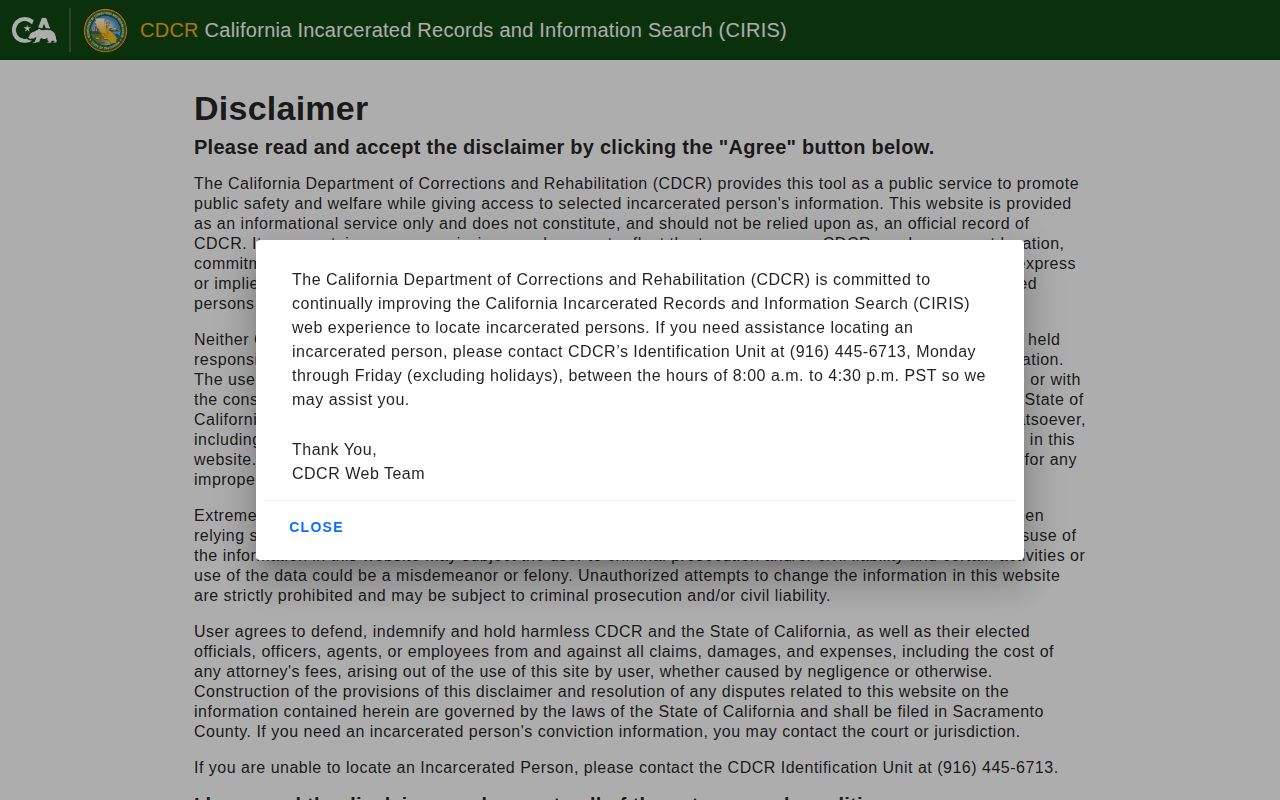
Split the work cleanly. Ask the county custodian for a booking photo and CDCR for a state custody record; neither lookup is a public photo gallery. Why might a county page have no booking photo? The roster may simply be text-only. California's public arrest-information rule does not require every jail to publish a photo online, so ask the custodian about its release policy.
California Mugshot Laws and Relief
Civil Code § 1798.91.1 targets paid removal. Its formal title is Commercial Use of Booking Photographs. The law bars a publisher or disseminator from asking for, requiring, or accepting payment to remove, correct, change, or withhold a person's booking photo. Each unlawful payment counts as a separate violation. The private civil action sets a floor. A claimant recovers the greater of $1,000 per violation or actual damages, plus costs and attorney fees. A public agency may still charge a reasonable administrative fee to correct its own record. The statute forces no county to post a photo. No deletion of every accurate page is promised.
Penal Code § 13665, by contrast, takes a different path. It generally stops law-enforcement agencies from posting booking photos for nonviolent crimes on social media. Exceptions exist. They cover a fugitive, an imminent safety threat, a court order, or an urgent legitimate law-enforcement need. Once posted, removal from the agency's social account is generally due within 14 days, subject to those exceptions. The rule does not treat a structured agency website or data system the same way.
The official Civil Code text lists the remedies.
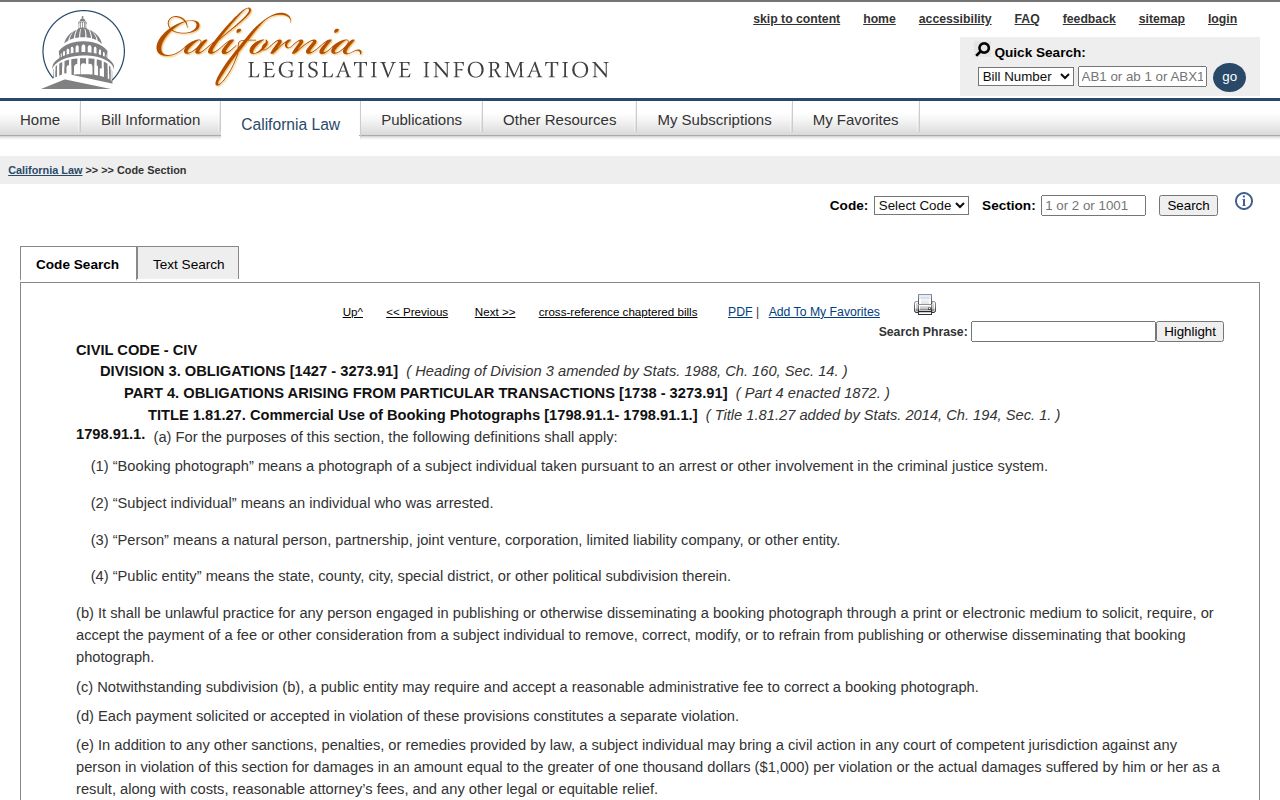
Found an inaccurate or legally restricted entry? Save its URL. Use the source's free correction route or the legal relief that fits the case; no paid removal offer is needed.
California relief is not one catch-all delete order. A court order or DOJ relief may change what an agency discloses. Still, another agency file, archive, or copied page can linger. The California Courts clean-record materials walk through the official paths and forms.
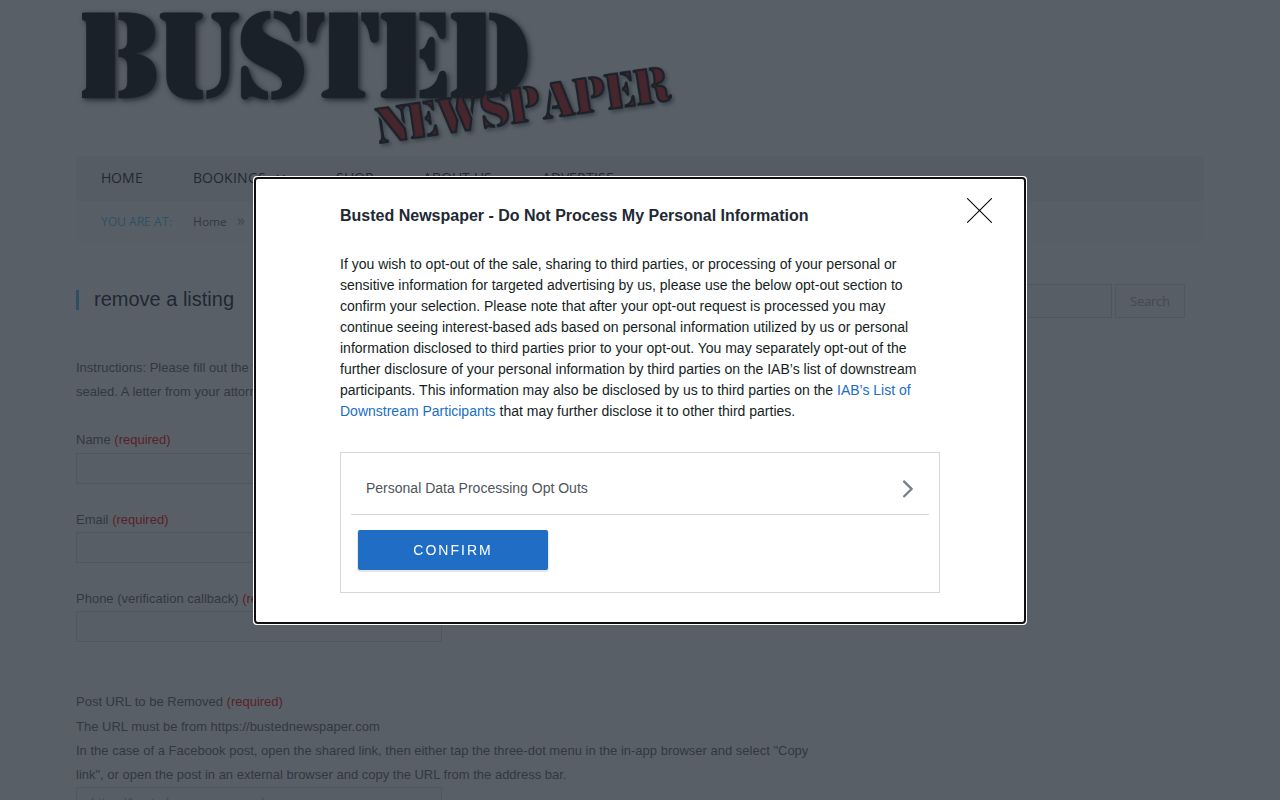
Some §20 publishers offer free documentation-based review. BustedNewspaper has a free form asking for the post URL and supporting documents, with a five-to-ten-day review period and no guarantee. RecentlyBooked reviews certain incorrect, sealed, expunged, or restricted records. Its terms say an accurate public record stays up even if someone objects. Mugshots.com also lists a free record-maintenance path with documentation. These are operator policies, and they can change.
Neither Arrests.org nor Mugshots.zone publishes a clearly posted California-specific free opt-out. Check each site for a current correction contact, and separately ask the originating agency or court to fix its own record. An online page can outlive a court or agency change to its copy.
One payment will not clear every copy. That promise is not a reliable legal route. Keep the page address, any court order, and use a publisher's documented free review path when one exists. Then press the official custodian to correct its record.
Where California Arrest Photos Appear
Official sources come first. A county roster or sheriff page is the place to confirm who is in custody. The arresting department holds its own report. The court file shows what happened later. Everything else is a copy. News stories and third-party pages follow their own update and correction rules. An old entry can linger or appear only in part. No copy on its own tells you current custody or a case result.
| Source | Role and photo status | How to read it |
|---|---|---|
| County sheriff or jail | Official booking and custody source; photo display varies. | Check county through the directory and read its stated window and photo policy. |
| Arresting police agency or CHP | Official arrest release or incident report; not a county-wide roster. | Use its records route, then identify the receiving jail. |
| Superior court | Official filing and disposition source; not a booking image feed. | Search the court where the case was filed. |
| CDCR | Official state-prison locator; no public photo is promised by CIRIS. | Use only for the state-custody trail. |
| VINE | Participating county or CDCR custody alerts; not an arrest archive. | Search one person and confirm a fresh booking with the county. |
| Third-party sites | RecentlyBooked, Mugshots.com, Arrests.org, BustedNewspaper, and Mugshots.zone are unofficial; coverage and freshness vary. | Verify every detail with the originating agency or court. A copied photo does not show guilt. |
California has no single statewide blotter. The Local Crime News site offers secondary arrest coverage by city and agency. Regional newsrooms report selected events too. That includes the Los Angeles Times California desk, the San Francisco Chronicle crime desk, the Sacramento Bee crime desk, and the San Diego Union-Tribune public-safety desk. An article may describe an arrest or run a booking photo in context. That is editorial coverage, not a custody search. Each publisher sets its own correction and archive rules.
Publication dates, correction cycles, and archive depth all differ from a sheriff roster. A story can report an arrest. It may say nothing about whether the person is still in jail. It also cannot settle a later court outcome on its own.
One example of a secondary state route is the RecentlyBooked California landing page. Its county coverage varies.
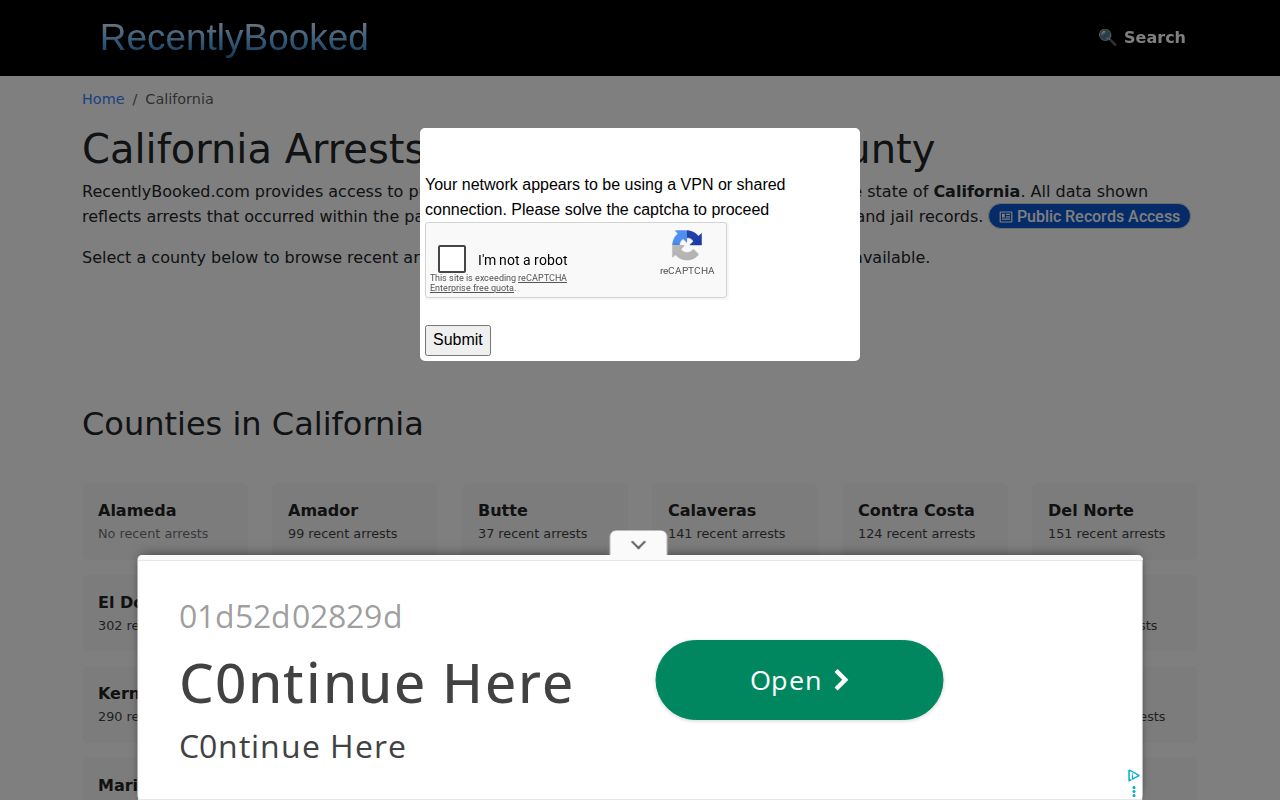
Any secondary page should point a visitor back to the official record for status, corrections, or a case result. The BustedNewspaper correction and removal form offers a free request route for qualifying documentation. Note: that form reflects the operator's policy, not a California agency service.
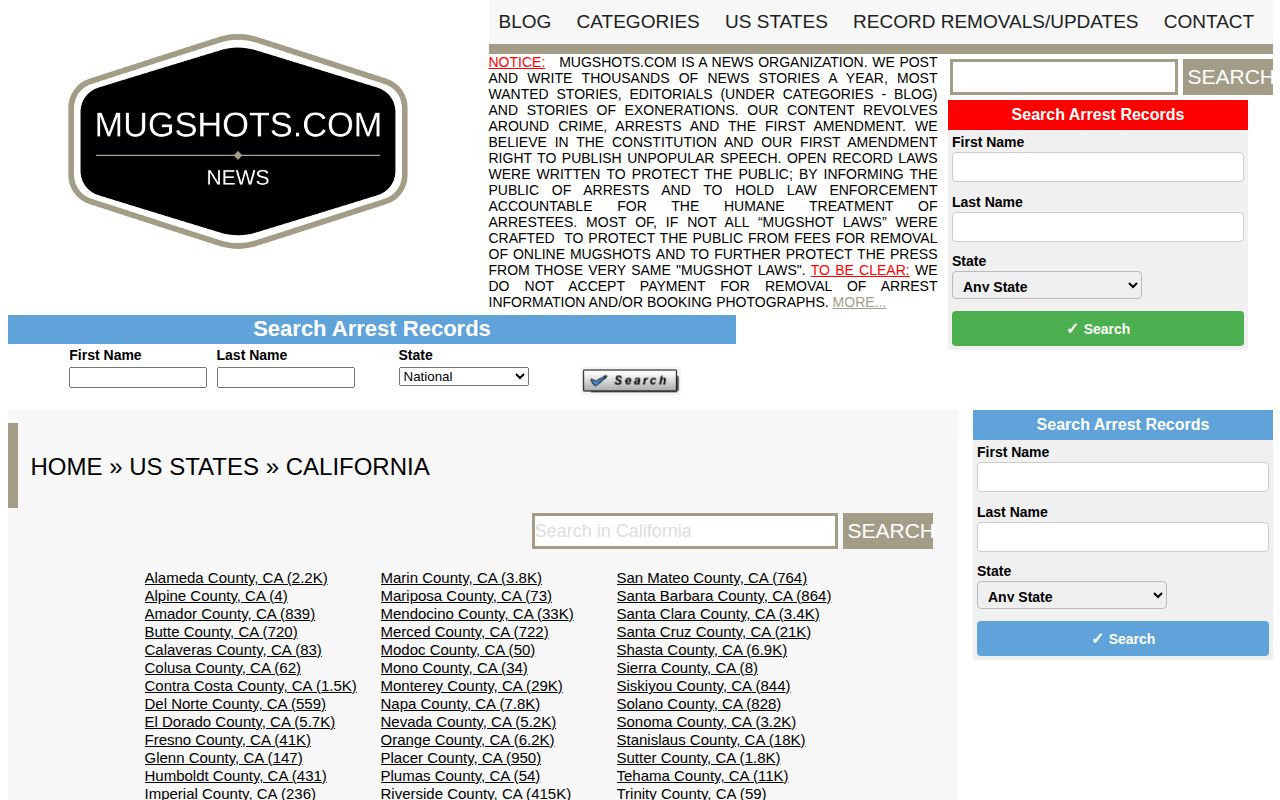
A publisher reviews each request under its own stated rules, and an accurate public record may still stay online. The Mugshots.com California archive route is unofficial and historical. It cannot settle whether a record is current.
An archive can outlive the county page that first posted an entry. So a visible copy proves nothing about whether the source record is still public. The Mugshots.zone national landing page does not amount to a complete California county index.
Mugshots.zone publishes no stable California route. A missing result there does not mean no official record exists.
California Warrants and Wanted Lists
Wanted notices ask for information. They are not arrest results. The California Attorney General Most Wanted page is the statewide official list, and a profile can carry a name, image, identifying details, and warrant context as the live page provides. A tip page never shows a court disposition. Never approach, follow, or try to detain anyone on a notice; use the official tip route for non-emergency information or call 911 for an immediate threat.
CDCR's Office of Correctional Safety describes its fugitive apprehension work, and its parole tip line routes non-emergency tips. The U.S. Marshals Service posts fugitive material by district, including a Central District of California page. A district page is not a state roster. Use the district selector for current material.
The DOJ's APPS database explanation describes an enforcement file that includes certain warrant information, but it is not a public person-by-person warrant search. California offers no single statewide page that replaces each sheriff or court for a local warrant check. To resolve a possible warrant, contact the court or agency through its official channel or ask a lawyer. Never guess from an arrest roster whether a warrant is active.
A safe warrant check follows the issuing authority. Start with the county court or sheriff source. Confirm any name match and current status with that office, since a local list can lag and a wanted profile never substitutes for the court's own record.
- Use the arrest location, case notice, or other reliable record to identify the county or court.
- Open that court or sheriff’s official warrant information route; use the county directory in the site navigation if needed.
- Ask the issuing office to confirm identity, status, and the lawful way to resolve the matter. A person concerned about a warrant can seek legal counsel.
- Send a tip to the named agency if a wanted notice asks for information. Do not approach or try to detain anyone.
California Arrest Records Over Time
A current roster can show one piece of an event. A kept agency record, a court file, and an archive can each show another. California sets no single retention period covering every county booking photo. The local-government schedule lists jail daily logs as "CU + 6" in one example. That is guidance, not a universal photo-destruction rule. The local custodian's schedule controls, and some historical records stay with a county while others move to the State Archives.
The California State Archives collections and its county-records guide describe jail registers, criminal-file indexes, and photographic files. Those finding aids make no promises. A county series may not have survived, may be closed, or may never have been digitized. Before requesting an old item, confirm the series, date span, access limits, and custodian. Note: an archive research request is separate from a modern sheriff CPRA request.
The Federal Bureau of Prisons locator covers federal prison custody and publishes no booking photos. The ICE Online Detainee Locator handles immigration detention. That system is apart from county jails, CDCR, and VINE. A "not in custody" result in one system does not say where a person is now.
| Record state | What the source can answer | What it cannot establish |
|---|---|---|
| Arrested | An agency records an alleged event and its reported time, place, and circumstances. | That the person was booked, remains held, or was found guilty. |
| Booked | A receiving jail records intake, identifiers, and charges as entered then. | That the booking charge is the final court charge. |
| In custody | A roster or VINE feed reports a current or recently reported holding status. | That the record is complete at the moment it is viewed. |
| Released | An agency records release time or manner when available. | Where the person went afterward or how the court case ended. |
| Sentenced to state prison | CDCR CIRIS may show state-prison custody and release details. | A new county arrest or a public booking-photo result. |
For an older arrest that has dropped out of live view, start by identifying the custodian and record series. A roster window closing is a display limit. It does not prove the booking record was destroyed. The BOP inmate locator is a federal prison search, not a California county arrest feed.
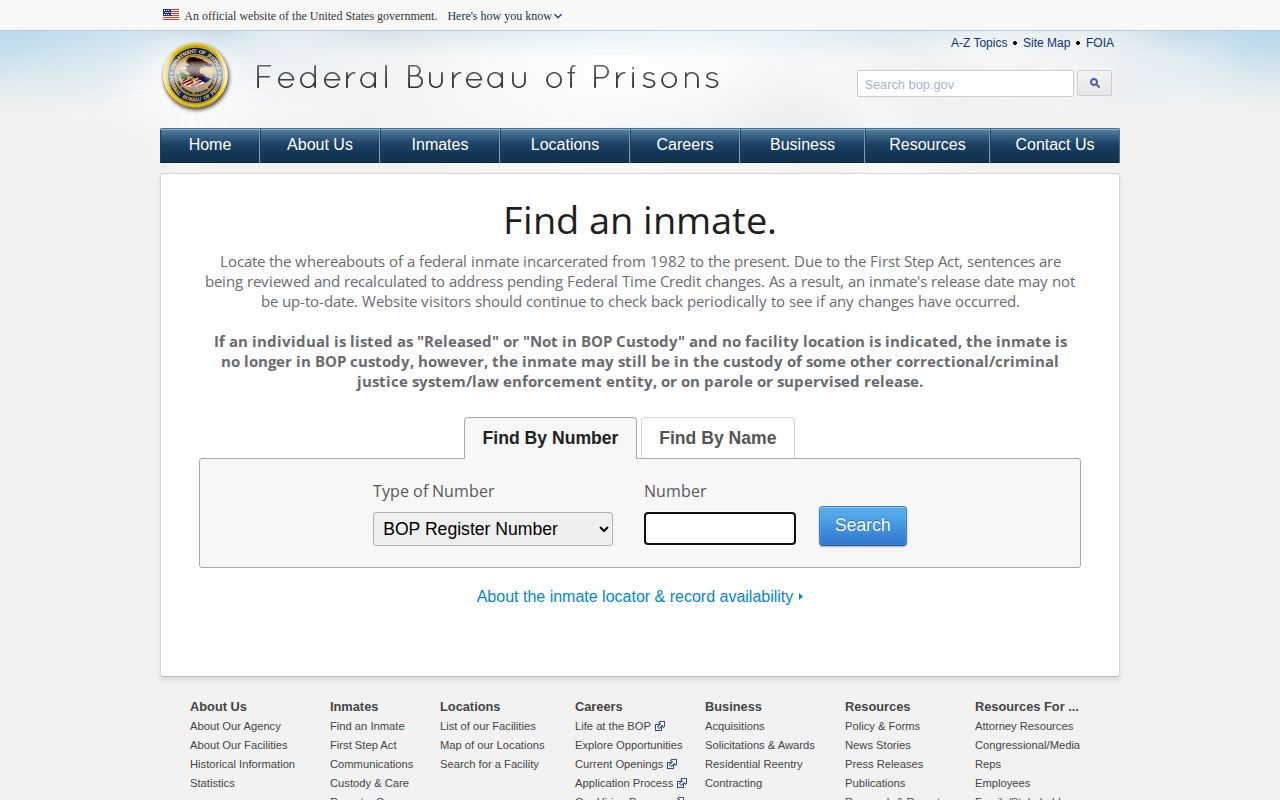
One caveat first. A federal result may list custody details, yet no public gallery of booking photos comes with it.
Old California arrest photos create their own problem. If a photo was lawfully removed or changed at its source, the search listing can lag behind.
Google's Refresh Outdated Content tool helps there. It flags a deleted or materially changed page, though it cannot erase the publisher's page or other copies.
- Booking
- The intake process that records a person received by a jail after an arrest.
- Arraignment
- An early court hearing where the person is told the filed charges and enters a plea.
- Bond
- Money or release conditions set to allow release while a case is pending; it is not a fine or a finding of guilt.
- Disposition
- The court’s recorded outcome in a case, such as dismissal, acquittal, or conviction.
- Expungement or sealing
- Common shorthand for legal relief that changes access or case status; it does not always erase every separate copy.