
California Arrest-Log Windows
California runs no statewide arrest blotter. There is no multi-day booking archive at the state level. So the trail starts with counties. Some sheriffs post rolling windows, others publish daily bulletins or weekly PDFs, and a few offer no public log at all. City departments add their own arrest and incident items on top of that. A jail log shows who was booked or held. A blotter may record a citation or a short account of an event.
Longer views matter once a same-day list rolls forward. A weekend batch can vanish the same way. A current inmate list drops people after release. A city log may say nothing about custody at all. So read the source name, the record type, the dates, and any archive controls before concluding a blank result means no arrest happened. Windows vary widely. Some span 48 or 72 hours, and some run seven or fourteen days. Some are weekly PDFs. For the short views, Arrested Today keeps them in one place.
County Multi-Day Arrest Logs
Put the date range beside every link. Butte publishes weekly PDFs. Kings runs a 72-hour query. Marin spans 48 hours and limits one view to people still in custody, while Solano caps at seven days compiled in daily periods. Calaveras and Amador post sheriff logs or bulletins, each with its own archive behavior.
| Official publisher | Published format | Reading limit |
|---|---|---|
| Butte County Sheriff | Weekly booking-log PDFs | Archive ranges, not a live same-day roster. |
| Calaveras County Sheriff | Press releases/logs and Citizen RIMS publications | News items and booking material may have different archive depth. |
| Amador County Sheriff | Daily media bulletins | An agency bulletin, not a complete state list. |
| El Dorado County Sheriff | Media bulletins | A bulletin fallback while its public arrests feature is disabled. |
| Kings County booking search | 72-hour query | A rolling booking window, not a historical archive. |
| Marin County Public Booking Log | 48-hour window plus current inmate list | One part covers people who remain in custody. |
| Solano County booking log | Seven-day maximum in daily periods | Compiled around midnight; check the live update note. |
The Butte County booking-log archive presents weekly ranges as official documents.
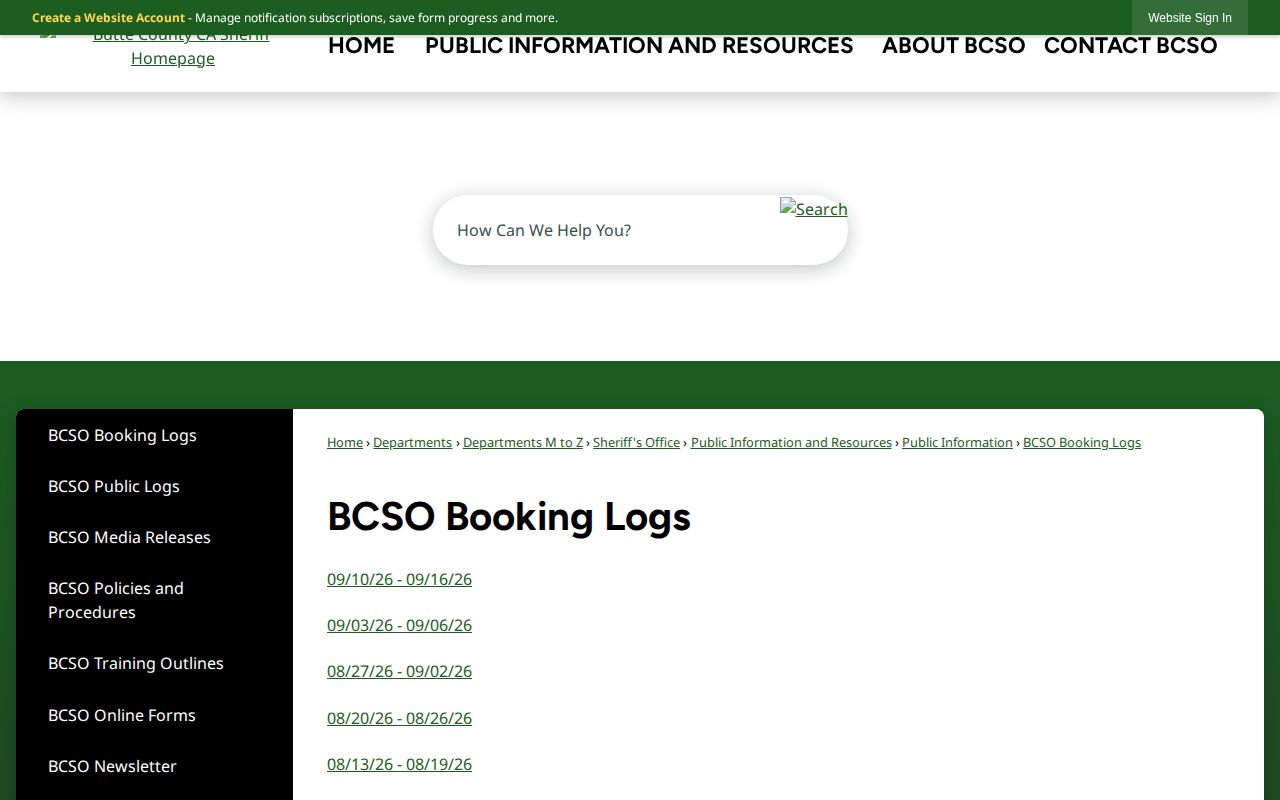
A weekly file is easier to date than a rolling list. Still, the PDF's own range sets the edge of what it covers.
Note: These local publication windows do not set the agency’s retention schedule, which depends on the custodian and record series.
California Arrest-Log Entry Fields
Formats vary across California. A blotter may show a name, an event date, a case number, a charge label, a release note, or a short account. No single required format exists. Compare what each official source provides.
| Entry field | How to read it |
|---|---|
| Agency and publication date | Names the publisher and when the item appeared; this can differ from the event date. |
| Arrest, booking, or event date | Read the field label. The three dates may not be the same. |
| Name, booking number, or case number | Compare an official identifier where available; names can overlap or use different spellings. |
| Charge or event description | States the reported charge or incident, not a court judgment. |
| Custody or release note | May describe booking or release but may not reflect a later transfer or current status. |
| Narrative or photo | Depends on the agency and its policy. No California log type guarantees a public photo. |
Brief bulletins leave details out, and disclosure limits can shape a record. A text-only log is still official, and a missing photo does not mean the custodian has none.
Read a California Arrest Blotter
Start with the question itself. Is it about a jail booking, a police event, current custody, or a court result? Each answer lives with a different agency. The same person can show up in several sources, with different dates and different stages of the same arrest.
- Identify the city or county where the arrest was reported and note the arresting agency if the source names it.
- Open the sheriff’s log or bulletin and read the date range, update note, and whether it covers bookings or current inmates.
- If a city police department made the arrest, check that department’s official blotter or release as a separate event source.
- For a highway incident, use CHP’s selected news releases or incident page for context, then identify the county that received the booking.
- For older material, ask the arresting agency or jail records unit which log, booking record, or report series may still be held.
Keep the item's date with your notes. The event can precede the booking, and the bulletin can lag behind both. Someone released after booking may vanish from an inmate list. The agency keeps the arrest report. The statewide California recent-arrests hub keeps county bookings separate from court and state-prison records.
Weekend California Arrest Reports
No California-wide rule governs weekend or holiday posting. Daily bulletins often arrive as batch products. A weekly PDF can group several dates into one file. County portals may refresh on a fixed clock while city logs follow their own schedules, so a weekend arrest can surface at very different speeds depending on where you look.
Compare three dates: event, booking, and publication. For current custody, check a live county roster or call the custodian. For an event older than a short list allows, use the publisher's archive controls or request the record.
Note: A holiday gap may shift publication timing, but the source research does not establish one statewide delay or batch day.
California City Police Logs
County jail rosters track who is in custody, but city police logs capture arrests at the department level. Visalia Police Arrest Logs publish a new arrest list every day. Oxnard lets visitors pull arrest data for yesterday, the last 7 days, or the last 14. Woodland keeps a city arrest-log page too.
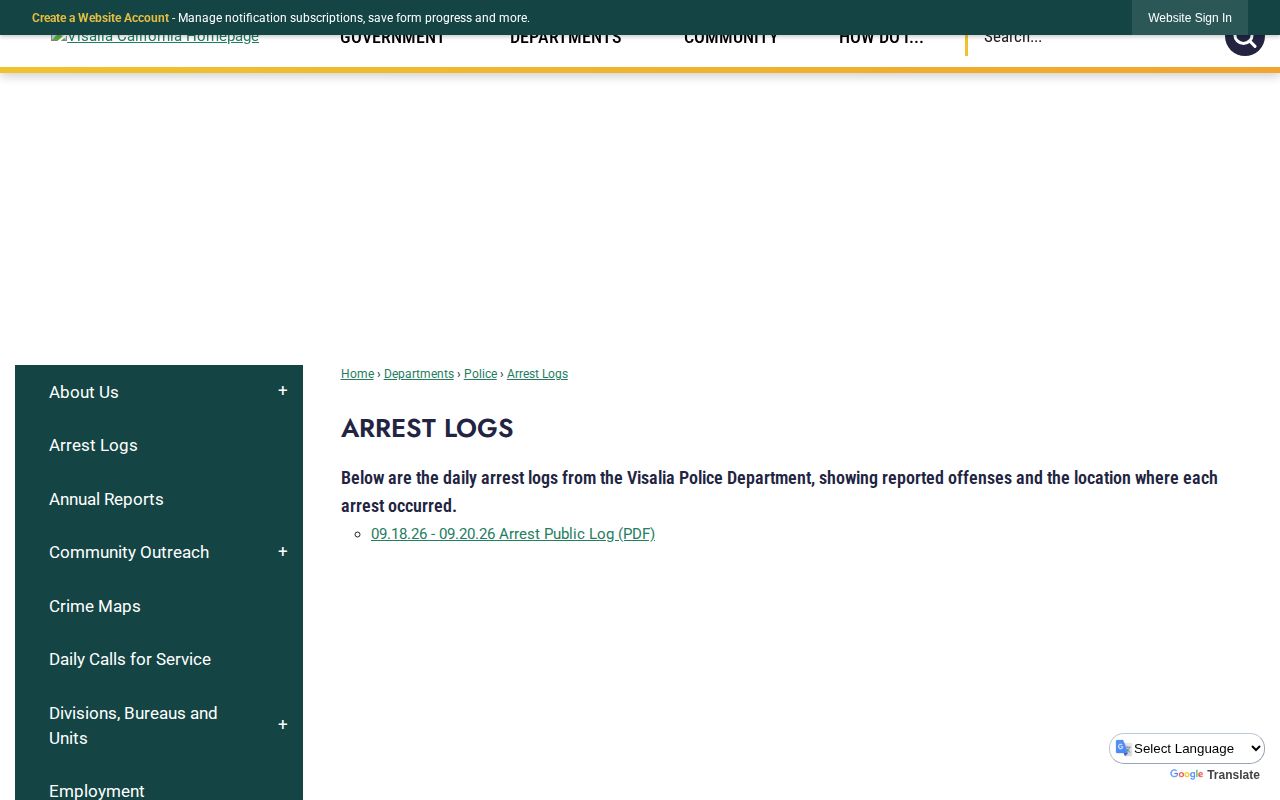
A city entry can document an arrest event without showing county custody. Oxnard's police logs let readers pick named date ranges. For a county view with a wider window, the Marin County Public Booking Log shows who is held in jail.
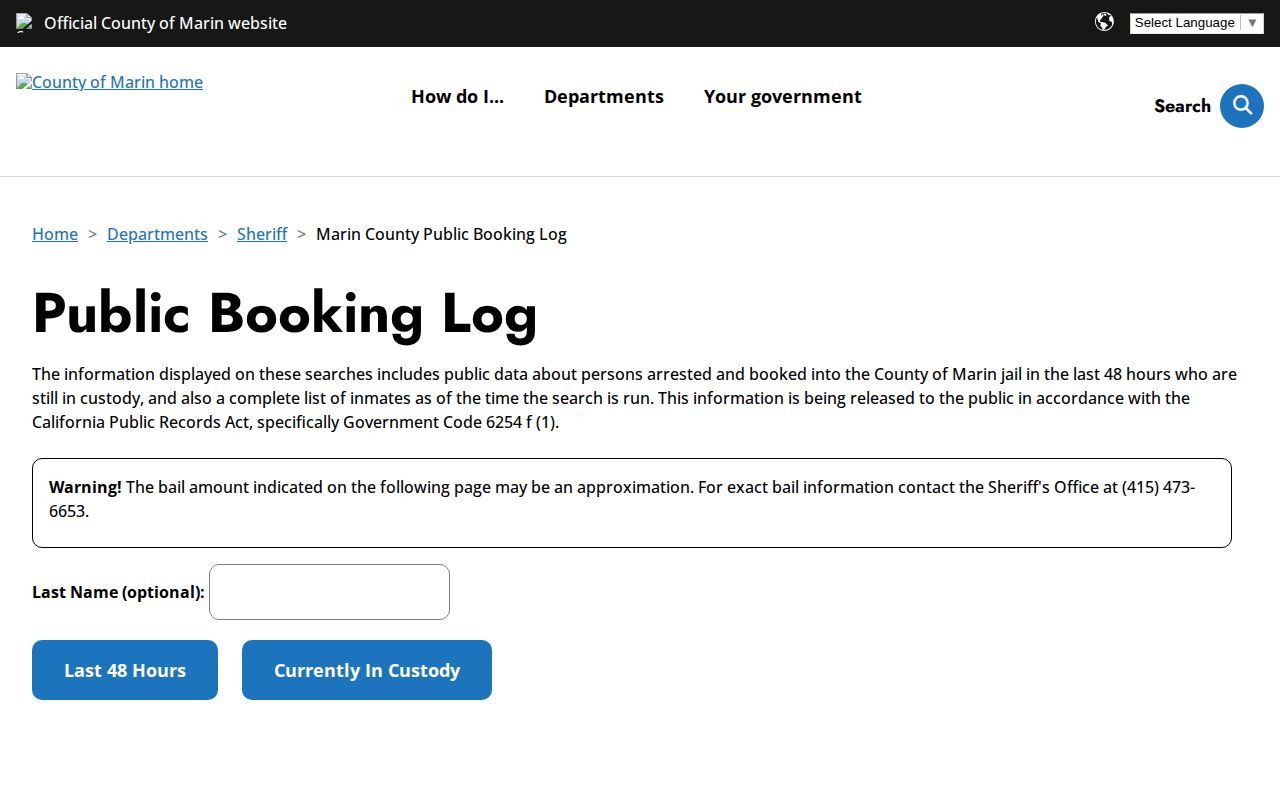
Marin's 48-hour custody-qualified view proves the point. An arrest event log and a jail list are separate record types, and they should stay that way.
California Rolling Arrest Windows
A multi-day label is not always an archive. Marin's 48-hour log includes only people booked who remain in custody. A released person disappears from view. It is not a permanent list of every arrest event. San Luis Obispo takes another approach. It posts a prior-24-hour date and time view. The view carries at least a one-hour delay. The date filter defines an interval. It preserves nothing older. That makes it different from a weekly PDF or a rolling multi-day list. The San Luis Obispo County Booking Log shows the time controls that frame a search.
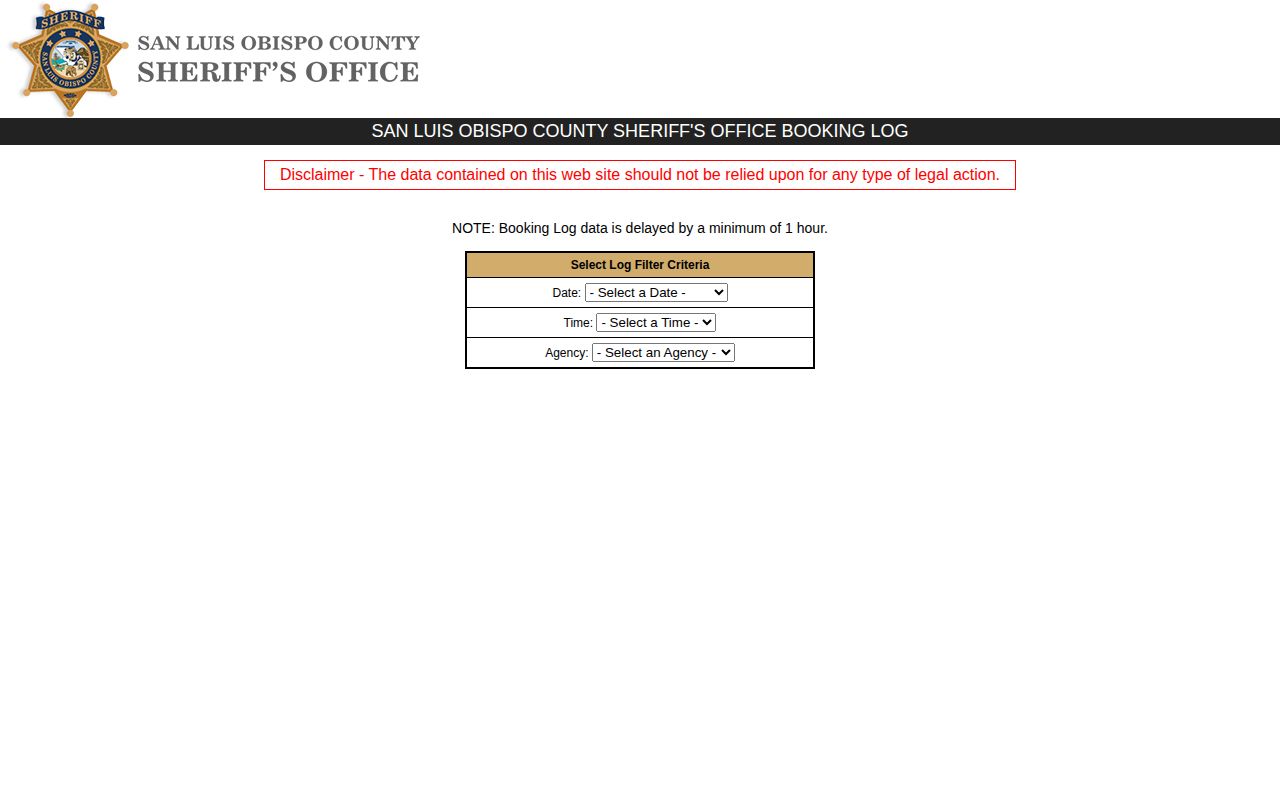
That one-hour delay is a freshness limit, not an archive period. Older entries require another publication or a request to the custodian.
CHP Arrest Releases and Incidents
CHP takes a different route. Its News and Alerts stream carries selected enforcement releases. Its Traffic Incident Information page is incident-oriented rather than a booking log. Someone arrested by CHP may end up in a receiving county jail. The county log is the better source. It covers that booking and current custody. CAD, news releases, and booking records each answer a different question.
California News Blotter Sources
California has no single statewide news blotter. Each regional newsroom decides which arrests and court stories it covers, on its own schedule. Four desks dominate the map: the Los Angeles Times California desk, San Francisco Chronicle crime coverage, the Sacramento Bee crime coverage, and the San Diego Union-Tribune public-safety desk. These are news outlets, not government rosters.
Corrections work differently at each paper. The Times links a corrections page for readers. The Chronicle posts a formal corrections policy. The Union-Tribune handles requests to change a story case by case. A correction route never guarantees removal of an accurate article.
Then there is Local Crime News, a private statewide arrest-news service. It is not a government database. Post dates, correction cycles, and archive policies can all differ from the agency that made the original arrest. Start with official logs. Use news accounts for context, and confirm any charge or outcome with the court.
Note: News dates and official booking dates can diverge, and a secondary page may remain after an agency’s short public window closes.
California Arrest Log Archives
How far back an arrest log goes depends on the publisher. Some sites keep a rolling window. Others save weekly PDFs. A few show only the current list. A third-party copy of a booking roster can linger online longer than the official version. Yet it can be stale or missing rows. A gap means the source hides it today, not that no record ever existed.
Need a recent county booking? Ask the sheriff or jail records unit through its public-records route. Name the arresting agency and give a date range. Say whether you want a booking log or an arrest report. The California Public Records Act generally gives the agency ten days for an initial determination. That deadline is extendable in unusual cases. That deadline does not promise every record arrives by then.
Booking photos have no single retention rule statewide. Each custodian and record series sets its own schedule. State guidance lists jail daily logs at current use plus six years in a public-safety table. That figure is an example, not a mandate. An online window can close while the agency still holds the record.
Older material lives elsewhere. The California State Archives collections and its historical county-records guide point to criminal-file indexes. They also point to jail registers and photographic files. The guide cannot promise a record survived, transferred, or is open.
The Archives' reference service quotes three to five business days for research, plus extra time for copies and mailing. Research itself carries no charge. Reproduction fees may still apply. Give staff a county, a likely record series, a name or incident, a date range, and a finding-aid number if you have one. The live fee page and access rules control.